

On the weekend of January 31 and February 1, Mustafa and I went to Brussels, to visit Fosdem. Fosdem is a large annual meeting for the open source community in Europe. It attracts over 8000 visitors each year, who can be found in 1 of 65 rooms, each with its own central theme: from Modern E-mail to Gaming & VR, and from Robotics to Security. Mustafa and I had a focus on the future of email for Superspace.
Fosdem and open source
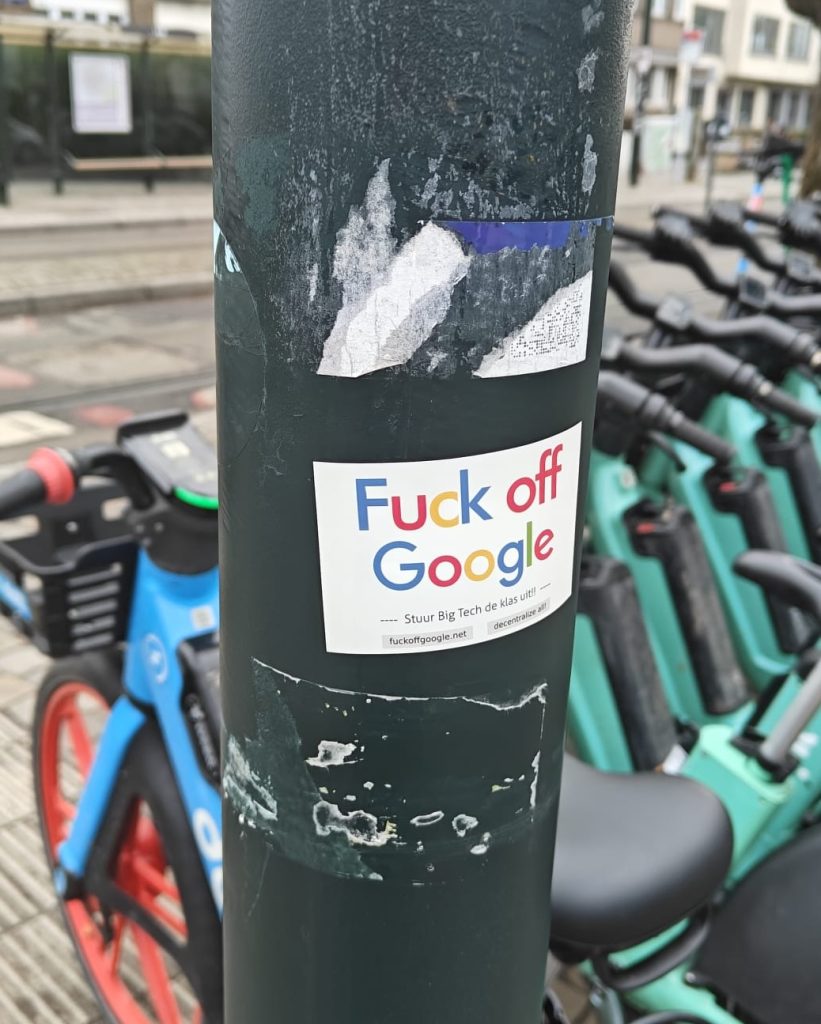
Fosdem is all about “free and open source software” - often explained as: “free as in freedom, not free as in beer.” That statement sums up the gist well. Free, open-source software is not about free software, but about freedom: the freedom to view, understand, modify and share the source code.
Open source versus closed software
Much software is developed by commercial parties who keep their source code closed, such as Coca-Cola's secret recipe. Users may use the software according to its terms, but have no insight into how it works.
With open source software, things are different. The source code is publicly available under an open license. That means developers can see the software, improve it and adapt it to their own needs. Those modifications can then be shared again.
The Internet as we know it is full of ‘closed source’ parties, but it cannot exist without open source software and open standards. Thanks to open standards, you can visit a website from your Windows computer that resides on our Linux server, and use your Superspace mail account to mail to Google. These things would not have been possible without open standards to which many volunteers are committed.
WordPress is one of the best examples of successful open-source software; some 95% of all public websites at Superspace use WordPress' open-source source code.
Stalwart & Modern E-mail
Our main reason for visiting Fosdem: to see how the world around modern email is evolving. Since early 2025, we at Superspace have been implementing Stalwart as a modern successor to the outdated cPanel mail platform; converting groups of customers to the system in small stages. We've had many different systems in the past (Zimbra, Open-Xchange, cPanel) with roots in the 1990s, and Stalwart promises to shake off that nostalgic weight.
Briefly, what makes Stalwart different:
- Architecture as a single scalable cluster running across multiple servers - easy to start small and scale up big without migrations and conversions.
- New project (started in 2020), built in Rust: which means Stalwart is fast and light.
- Full commitment to JMAP: modern and unified protocol for e-mail, calendars and contacts, easier configuration, better performance on slow connections.
Webmail clients
The morning program consisted of a number of presentations on webmail. Here the developers of Parula and OpenCloud, among others, showed their e-mail clients, which were also getting ready for the JMAP protocol. It was good to see that JMAP is an important topic among these developers; even though it is clear that it is often still in its early stages.
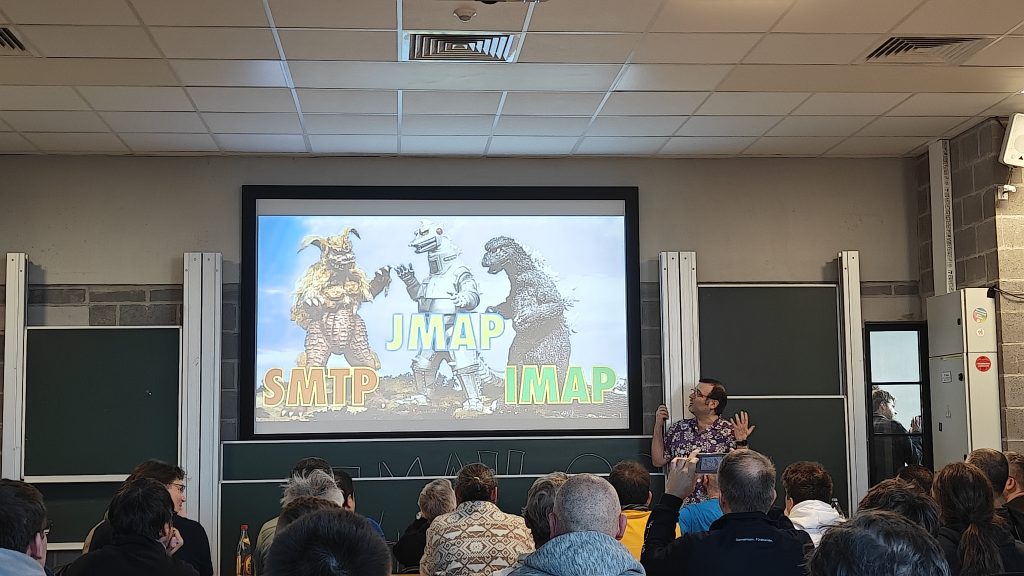
JMAP; “destroy all monsters”
I already mentioned the JMAP protocol a few times in this blog post. Ricardo Signes of Fastmail explained in an interesting and entertaining presentation how JMAP as a unified protocol makes open-source e-mail easier, more accessible and better by bringing all kinds of protocols (IMAP, SMTP, CalDAV, CardDAV, WebDAV) under 1 standard.
JMAP is not a panacea, but it addresses many of the practical problems that have dragged on with IMAP/SMTP for decades.
Stalwart: Can Open Source do Gmail-scale Email?
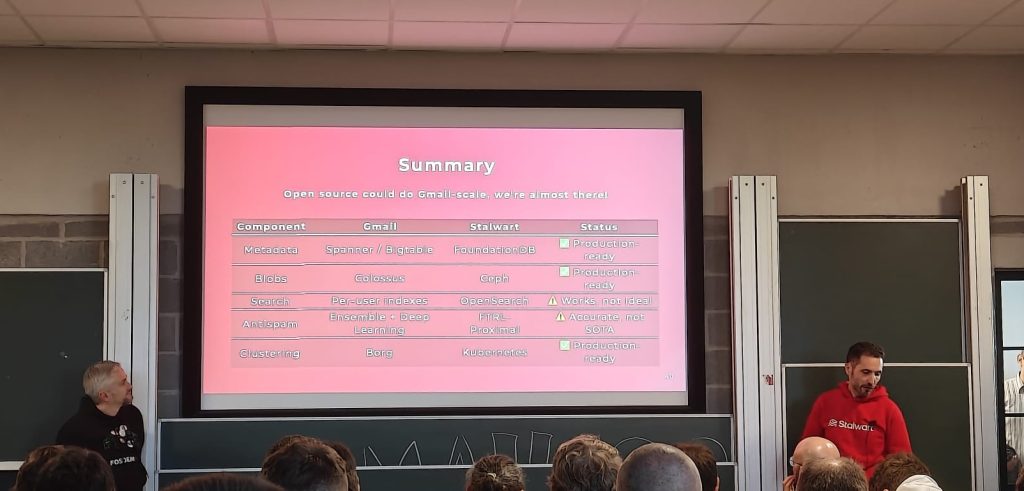
Developer Mauro's Stalwart presentation was the highlight of the day: he took the audience through his ambition to use open source to build software that can compete with the large scale of a provider like Gmail. Mauro showed what is already possible in Stalwart and what remains to be done.
The way Stalwart stores data is already hugely scalable. The software itself can be easily expanded; because the data itself can be spread across multiple ‘backends.
Stalwart's biggest challenge is still search and spam filtering. Software such as ElasticSearch can search through large amounts of data well, but has limits. Meilisearch, on the other hand, cannot scale larger than 1 node.
A second challenge is still reliable spam filtering. Current methods scale well and are already quite accurate, but are nowhere near as good as big tech's. Mauro indicated that AI-based solutions hold a lot of promise, but are currently too slow and expensive to run at large scale. Mauro is considering a hybrid model for this; combining LLMs and more advanced algortimes.
The presentation was a great way for us to learn how the platform is put together, and how far along development is. It did make it clear that the biggest improvements still need to come in the user experience; such as that search function and spam filtering. Developing a nice webmail client is not yet on the top priority list for Stalwart's team.
Conclusion
Fosdem painted a clear picture: the modern e-mail stack is moving toward simpler protocols (JMAP), faster deployments (Rust/Stalwart) and an ecosystem ready to offer users more than just e-mail. Stalwart has a lot of potential for Superspace Mail, but there is still work around search functionality and spam filtering before it runs smoothly on a large scale. In addition, the webmail experience is also still a challenge; since there is no full-fledged JMAP webmail ready for production yet.
We will continue to test, and contribute where necessary, so that we can make our e-mail service truly super.
Should your interest have been piqued by this blog, you can watch the various presentations back through the Fosdem website; https://fosdem.org/2026/schedule/track/modern-email/

